Homeless Strategy
Sandra Adam-Couralet for Salon de Montrouge 2014
antoine-renard-montrouge.pdf
EN (FR below)
Antoine Renard’s sculptures are first of all the result of action. Nothing is truly created ex nihilo. Rather it is recycled, transposed, regenerated.
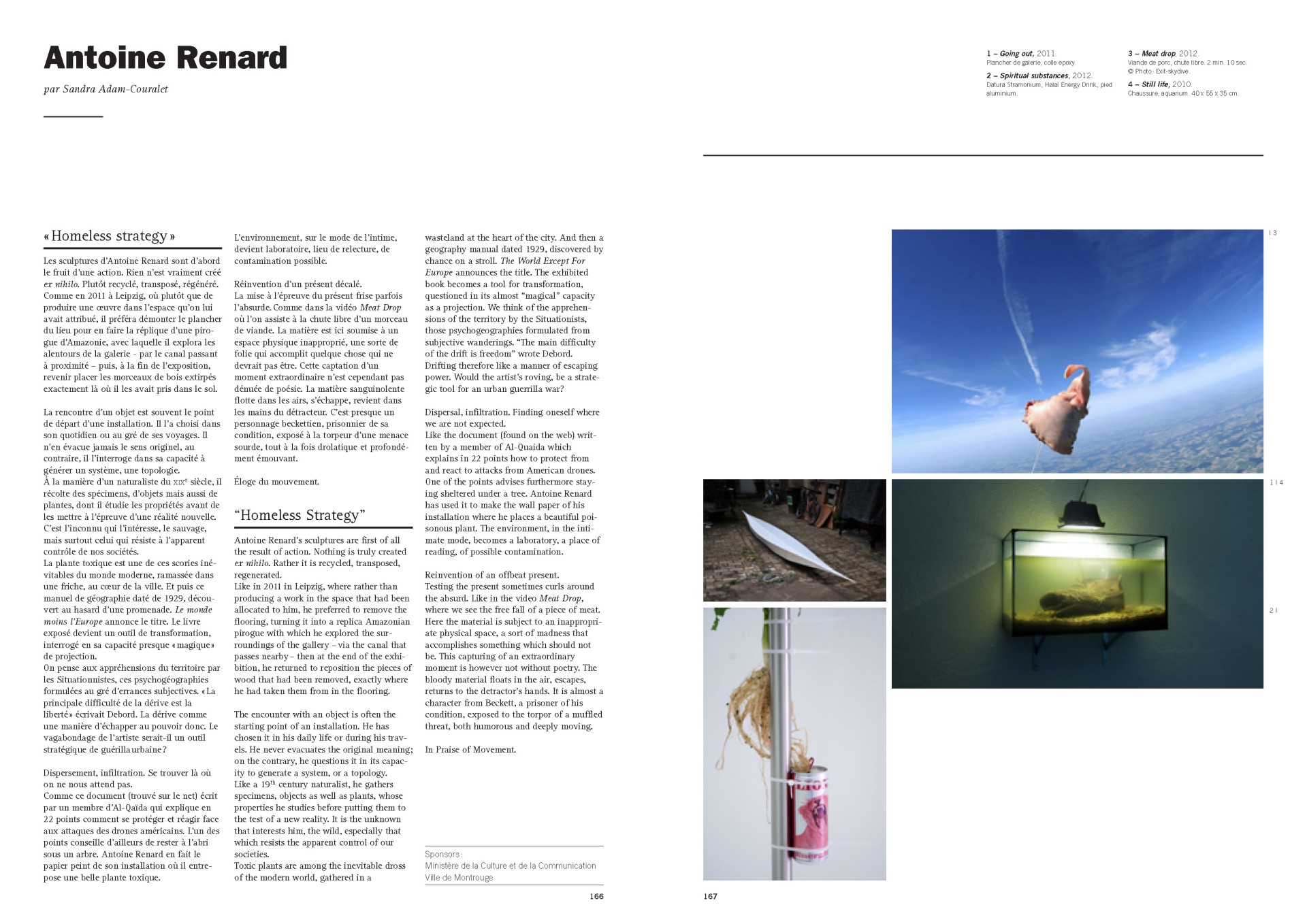
Like in 2011 in Leipzig, where rather than producing a work in the space that had been allocated to him, he preferred to remove the flooring, turning it into a replica Amazonian pirogue with which he explored the sur- roundings of the gallery – via the canal that passes nearby – then at the end of the exhi- bition, he returned to reposition the pieces of wood that had been removed, exactly where he had taken them from in the flooring.
The encounter with an object is often the starting point of an installation. He has chosen it in his daily life or during his trav- els. He never evacuates the original meaning; on the contrary, he questions it in its capac- ity to generate a system, or a topology.
Like a 19th century naturalist, he gathers specimens, objects as well as plants, whose properties he studies before putting them to the test of a new reality. It is the unknown that interests him, the wild, especially that which resists the apparent control of our societies.
Toxic plants are among the inevitable dross of the modern world, gathered in a wasteland at the heart of the city. And then a geography manual dated 1929, discovered by chance on a stroll. The World Except For Europe announces the title. The exhibited book becomes a tool for transformation, questioned in its almost “magical” capacity as a projection. We think of the apprehen- sions of the territory by the Situationists, those psychogeographies formulated from subjective wanderings. “The main difficulty of the drift is freedom” wrote Debord. Drifting therefore like a manner of escaping power. Would the artist’s roving, be a strate- gic tool for an urban guerrilla war?
Dispersal, infiltration. Finding oneself where we are not expected.
Like the document (found on the web) writ- ten by a member of Al-Quaida which explains in 22 points how to protect from and react to attacks from American drones. One of the points advises furthermore stay- ing sheltered under a tree. Antoine Renard has used it to make the wall paper of his installation where he places a beautiful poi- sonous plant. The environment, in the inti- mate mode, becomes a laboratory, a place of reading, of possible contamination.
Reinvention of an offbeat present.
Testing the present sometimes curls around the absurd. Like in the video Meat Drop, where we see the free fall of a piece of meat. Here the material is subject to an inappropri- ate physical space, a sort of madness that accomplishes something which should not be. This capturing of an extraordinary moment is however not without poetry. The bloody material floats in the air, escapes, returns to the detractor’s hands. It is almost a character from Beckett, a prisoner of his condition, exposed to the torpor of a muffled threat, both humorous and deeply moving.
In Praise of Movement.
__
FR
Les sculptures d’Antoine Renard sont d’abord le fruit d’une action. Rien n’est vraiment créé ex nihilo. Plutôt recyclé, transposé, régénéré. Comme en 2011 à Leipzig, où plutôt que de produire une œuvre dans l’espace qu’on lui avait attribué, il préféra démonter le plancher du lieu pour en faire la réplique d’une piro- gue d’Amazonie, avec laquelle il explora les alentours de la galerie - par le canal passant à proximité – puis, à la fin de l’exposition, revenir placer les morceaux de bois extirpés exactement là où il les avait pris dans le sol.
La rencontre d’un objet est souvent le point de départ d’une installation. Il l’a choisi dans son quotidien ou au gré de ses voyages. Il n’en évacue jamais le sens originel, au contraire, il l’interroge dans sa capacité à générer un système, une topologie.
À la manière d’un naturaliste du XIXe siècle, il récolte des spécimens, d’objets mais aussi de plantes, dont il étudie les propriétés avant de les mettre à l’épreuve d’une réalité nouvelle. C’est l’inconnu qui l’intéresse, le sauvage, mais surtout celui qui résiste à l’apparent contrôle de nos sociétés.
La plante toxique est une de ces scories iné- vitables du monde moderne, ramassée dans une friche, au cœur de la ville. Et puis ce manuel de géographie daté de 1929, décou- vert au hasard d’une promenade. Le monde moins l’Europe annonce le titre. Le livre exposé devient un outil de transformation, interrogé en sa capacité presque «magique» de projection.
On pense aux appréhensions du territoire par les Situationnistes, ces psychogéographies formulées au gré d’errances subjectives. «La principale difficulté de la dérive est la liberté» écrivait Debord. La dérive comme une manière d’échapper au pouvoir donc. Le vagabondage de l’artiste serait-il un outil stratégique de guérillaurbaine?
Dispersement, infiltration. Se trouver là où on ne nous attend pas.
Comme ce document (trouvé sur le net) écrit par un membre d’Al-Qaïda qui explique en 22 points comment se protéger et réagir face aux attaques des drones américains. L’un des points conseille d’ailleurs de rester à l’abri sous un arbre. Antoine Renard en fait le papier peint de son installation où il entre- pose une belle plante toxique.
L’environnement, sur le mode de l’intime, devient laboratoire, lieu de relecture, de contamination possible.
Réinvention d’un présent décalé.
La mise à l’épreuve du présent frise parfois l’absurde.Comme dans la vidéo Meat Drop où l’on assiste à la chute libre d’un morceau de viande. La matière est ici soumise à un espace physique inapproprié, une sorte de folie qui accomplit quelque chose qui ne devrait pas être. Cette captation d’un moment extraordinaire n’est cependant pas dénuée de poésie. La matière sanguinolente flotte dans les airs, s’échappe, revient dans les mains du détracteur. C’est presque un personnage beckettien, prisonnier de sa condition, exposé à la torpeur d’une menace sourde, tout à la fois drolatique et profondé- ment émouvant.
Éloge du mouvement.